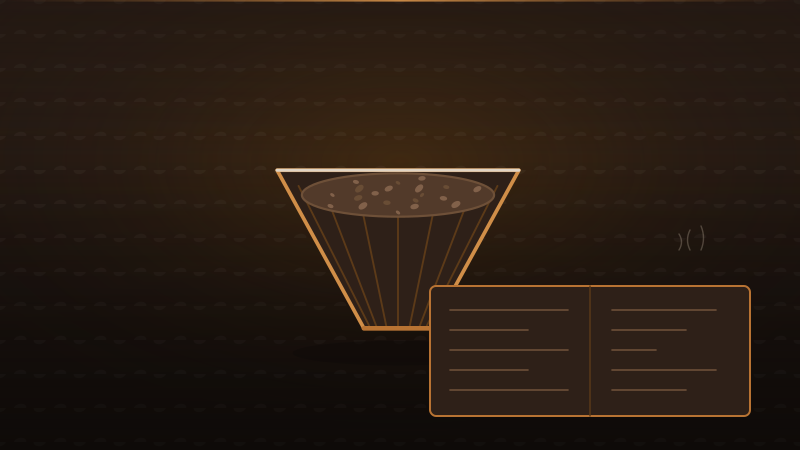
The method is simple: hot water passes through a bed of coffee in a paper filter. What separates the brewers is the shape of the bed, the thickness of the filter, and how much control the design leaves in your hands.
The four variables
- Water temperature — 92–96 °C for most roasts. Lower for dark, higher for light.
- Grind size — medium to medium-fine, roughly table salt. Finer stalls the brew, coarser drains too fast.
- Ratio — 1:15 to 1:17. Start at 1:16 and adjust to taste.
- Pour — the pattern, the rate and how evenly you keep the bed level.
Check any combination against the coffee ratio calculator before you brew, and use a scale with a timer for every pour.
V60
A 60-degree cone with spiral ribs and one large exit hole. The ribs lift the paper off the wall so air and water can move, and the single large hole means the flow is governed by the coffee bed rather than the dripper. The result is the most transparent of the three — it shows you exactly what your grind and pour are doing, which is why it is the best learning tool.
The trade-off is that it is also the most sensitive. A pour that disturbs the bed shows up immediately in the cup. See the V60 guide.
Chemex
A one-piece glass flask with an unusually thick bonded filter. That filter holds back oils and fine particles, so the cup is clean and light-bodied with high clarity. If you want body and oils, this is the wrong brewer — that is what a French press is for.
Because the filter is thick, the grind wants to be coarser than a V60 and the brew runs longer. The Chemex guide has the numbers.
Kalita (flat-bed)
A flat-bottomed dripper with three small holes instead of one large one. The flat bed gives a more even extraction and a more forgiving brew: the small holes restrict the flow, so a slightly uneven pour does less damage. If a V60 is frustrating you, a flat-bed dripper is the usual next step.
| Brewer | Bed | Character | Best for |
|---|---|---|---|
| V60 | Cone, one large hole | Transparent, sensitive | Learning the method |
| Chemex | Cone, thick filter | Clean, light-bodied | Clarity and larger batches |
| Kalita | Flat, three small holes | Even, forgiving | Consistency |
A method that works on all three
Rinse the filter
Hot water through the paper removes paper taste and preheats the brewer in one step. Discard the water.
Bloom
Pour twice the coffee weight in water, then wait 30–45 seconds. The bed swells and releases gas; pouring through it before it settles gives an uneven extraction.
Pour in stages
Two or three pours, in slow spirals from the centre outward, keeping the water level steady and the bed flat.
Drawdown
Let the bed drain fully. Total time, including the bloom, should land between 2:30 and 3:30 for a V60.
A gooseneck matters more than the cone
A wide-spouted kettle dumps water in a rush and disturbs the bed. A [gooseneck kettle](/tool-gooseneck-kettle.html) turns the pour into a variable you control, which is most of what pour over is.
When it goes wrong
| Problem | Likely cause | Fix |
|---|---|---|
| Brew drains too fast, tastes thin | Grind too coarse | Grind finer in small steps |
| Brew stalls completely | Grind too fine, or too many fines | Grind coarser; pour more gently |
| Bitter and dry | Water too hot, or over-extracted | Drop to 90–92 °C and shorten the brew |
| Sour and sharp | Under-extracted | Raise the temperature and grind finer |
If you want to see the bed drain in three dimensions before you brew, the pour over simulator models the bloom and drawdown against your settings.